

From Everyday Drinking: "I Looked at 1,000 Wine Lists. The Data Says the State of Fine Wine is Boring and Overpriced."
I studied the numbers from 1,063 Michelin-starred wine lists. I thought I'd uncover hidden gems, but that’s not what I found.


Exciting news! Jason Wilson invited me to write a monthly column for his very trendy Everyday Drinking, where I’ll be looking at wine through a more analytical lens — that’s to say, taking some of the emotion out of wine.
Then, if that wasn’t exciting enough, I finally get to publish the result of five months of work with start-up WineLabs and its founder, Ilias Miraoui: what is probably the largest analysis ever conducted of wine lists from 1,063 Michelin-starred restaurants worldwide.
Read what I found out.
“All you have to do is write one true sentence,” Ernest Hemingway would say to himself, to combat his writer’s block. “Do not worry. You have always written before and you will write now. All you have to do is write one true sentence. Write the truest sentence that you know.”
Can that be applied to data? It’s worth trying, as I’ve been stuck on this analysis for what feels like forever.
For the past six months, I’ve worked with a start-up, WineLabs, and its founder, Ilias Miraoui, to build what is the largest analysis of wine lists from 1,063 Michelin-starred restaurants worldwide. The idea was simple: if these are the best restaurants, with the best sommeliers and the deepest cellars, what do they actually serve? My hypothesis was that we would uncover niche wine markets—hidden gems known only to insiders. But that’s not what we found.
The truest sentence I know is this:
After six months of cleaning data, Ilias and I found that Krug and Dom Pérignon appear on 42 percent of all Michelin wine lists.
Among the most represented producers, beyond these two Champagne houses, the pattern is equally conventional: Château d’Yquem, Gaja, Bollinger, Louis Roederer, Sassicaia, Château Margaux, Ruinart, Domaine Leflaive, Château Mouton Rothschild, Vega Sicilia, Domaine de la Romanée-Conti, and Château Haut-Brion.
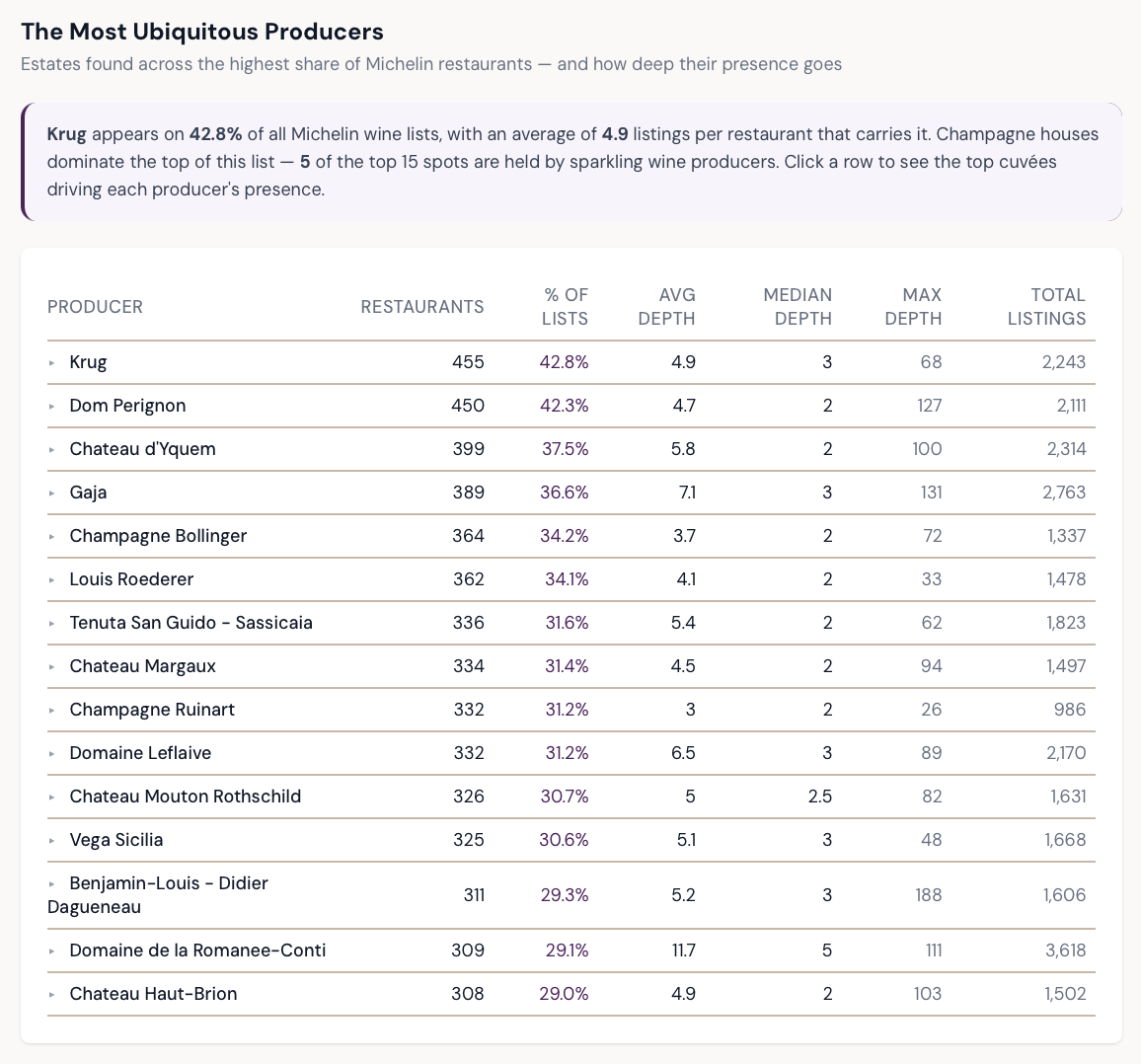
Hopefully, that is not where the story ends, but it is where it starts. It starts with a question: are wine choices at the top end of the market homogeneous— homogeneous to the point of being boring?
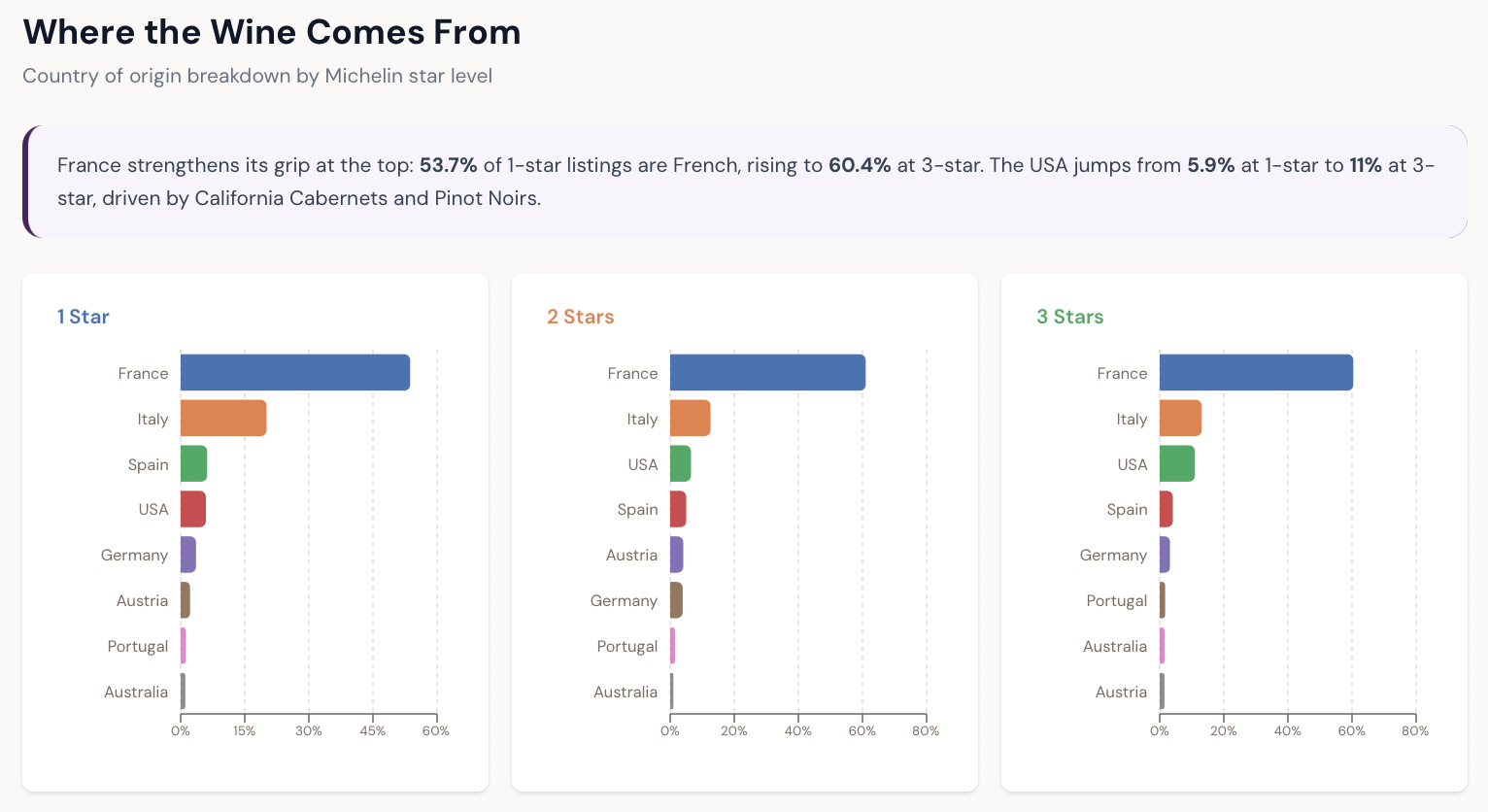
The data suggests they are. Around 60 percent of wine lists are dominated by French regions, primarily Burgundy, Bordeaux and Champagne, with smaller contributions from the Rhône and the Loire. Italy is a distant second, accounting for roughly 10 to 20 percent of listings.
This concentration is not entirely organic. On the topic of Champagne, Michelin-starred restaurants sometimes have exclusivity agreements with certain houses, whereby a glass is served on arrival and bottles are available at a more favourable price. “However,” a sommelier at one such restaurant told me, “it becomes difficult to sell anything else sparkling.”
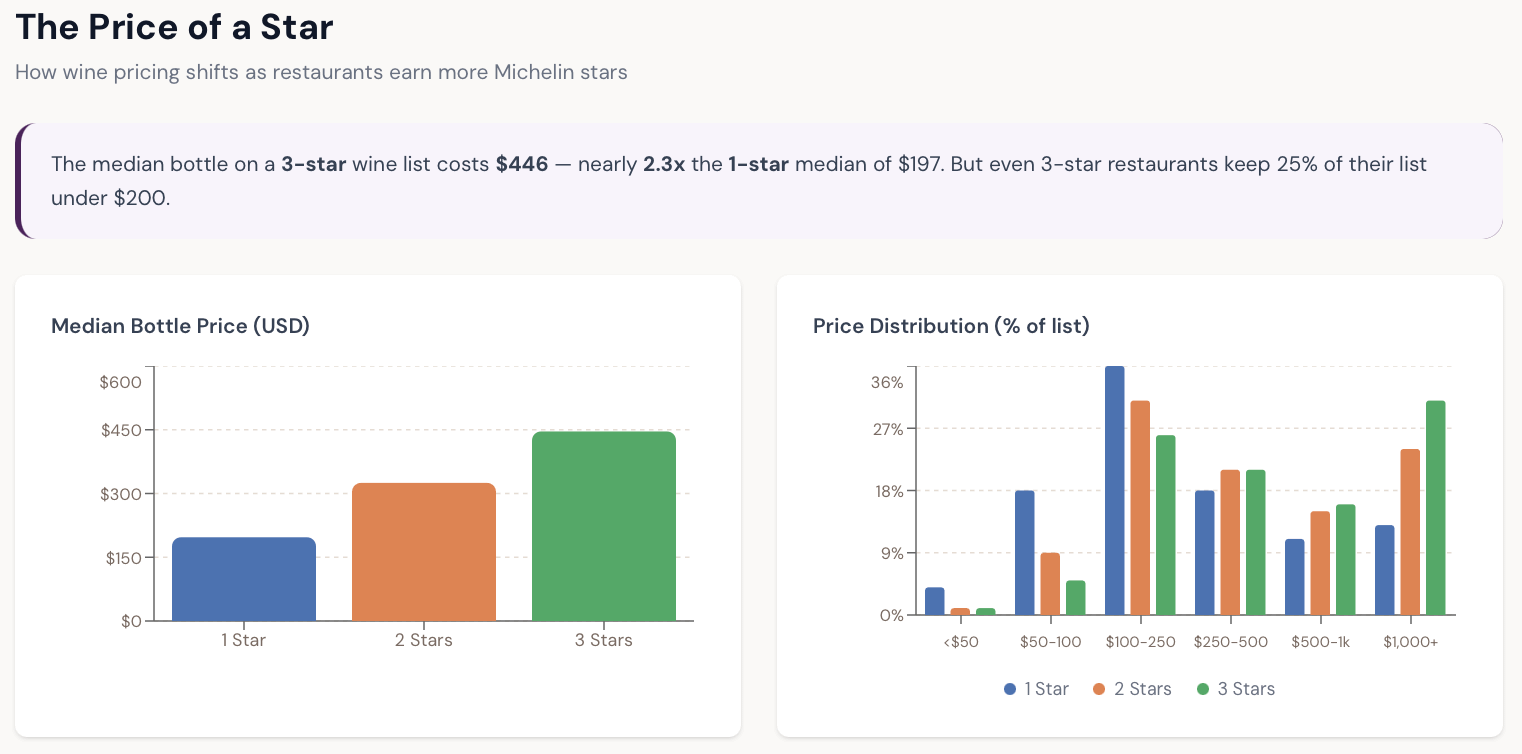
Another equally predictable finding: median bottle prices increase with star level, US$197 for one-star, US$325 for two-star, and US$446 for three-star Michelin restaurants. A quarter of two-star and a third of a 3-star menus are comprised of bottles above $1,000. Meanwhile, only 6 percent of the menus consist of bottles less than $100.
For context, the median price of the most expensive tasting menus is US$165, US$256 and US$356 for one-, two- and three-star restaurants, respectively1. Given that a tasting menu usually lasts between two and four hours, it is not unreasonable to assume that at least one bottle of wine will be consumed per person. Those bottles of wine will each be priced 18 percent to 27 percent above the most expensive tasting menu.
Having spoken to sommeliers, low- and no-alcohol pairings are becoming increasingly popular. Alternatives—low- and no-alcohol beverages, cocktails, and, not least, water—come in at way less than half the price of wine.
Does this mean that fine wine is pricing itself out of, arguably, the only establishments that can realistically sell bottles above $1,000—and where wine producers themselves want to be present—all in the pursuit of status and high prices for their own sake? Is status what’s killing fine wine?
I keep seeing statements like “alcohol is in structural decline due to changing youth culture and GLP-1s dampening consumption” presented as fact—but they are assumptions, not facts. I disagree; I think the decline is primarily driven by price, and more importantly by the availability of better value-for-money alternatives.
I can’t untangle which came first: fine wine producers raising prices to excess, or high-end restaurants treating wine as a cash cow. What starts as positioning becomes pricing. What starts as pricing becomes expectation. And what starts as expectation becomes a system that is very hard to unwind. But the outcome of this vicious cycle is clear—the lack of fine wine at reasonable prices is what puts consumers off.
One sommelier told me that when they started working at a Michelin-starred restaurant, they saw the same wine they had sold in a shop priced at eight times as much. “The ambience, the food and the scenography of a Michelin-star restaurant do a lot to elevate the wine.”
I find it infuriating myself: going to a restaurant—admittedly rarely a Michelin-starred one—where the choice is between an expensive glass of Veuve Clicquot or a non-descript “wine from Chile” at an excessive price. More often than not, I just get a beer.
In other words, consumers are not necessarily drinking less—they are substituting. And in that substitution, wine is losing.
Academic research points in the same direction. A recently published study by Riccardo Saracino, Stefano Corsi and Chiara Mazzocchi, “The STAR WARS of Michelin Guide restaurants: a wine list perspective — a case study from Italy,” analyzes the factors influencing restaurant ratings, including wine lists. “It turns out that,” they write, “wine list characteristics play a significant role in shaping customer satisfaction.”
Evidence suggests that customers appreciate wine lists offering a balance between affordable and premium-priced wines, suggesting that price diversity is a valued feature. While higher prices can increase customer satisfaction, this effect reverses beyond a certain point. In the case of wine, lower median prices are associated with higher ratings, suggesting that customers are sensitive not just to price, but to value.
At the same time, wine lists that are too narrow—whether overly local or overly conventional—tend to perform worse.
In other words, consumers are not rejecting wine; they are rejecting overpriced and predictable wine—which, incidentally, is what these menus increasingly offer.
The question is whether Michelin’s methodology, which clearly rewards a certain way of delivering excellence in food, is also painting the world of food and wine “beige.” A kind of “beigification”, technically flawless, globally consistent, but lacking distinction. And that is exactly what the data reflects: not a lack of quality, but a convergence of choices.
On YouTube, I came across an urban architect showing images of new builds and asking: “Why does this look like it could be anywhere, while these”—showing Amsterdam, Santorini and Brooklyn—“are clearly from a specific place?”
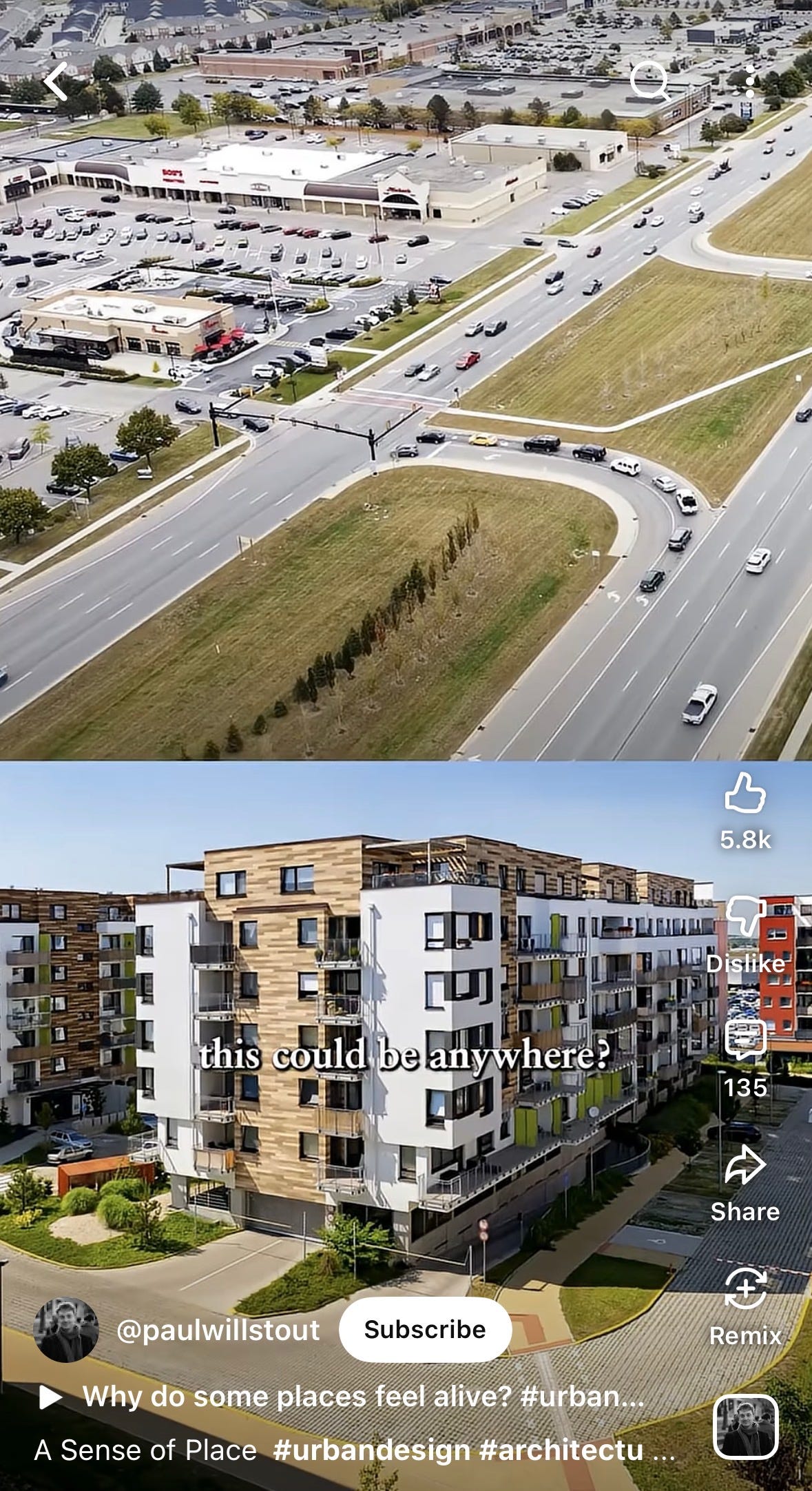
He explains it through the idea of a “sense of place,” the elements that make a location distinctive. Brooklyn’s brownstones come from locally available stone; Dutch brick architecture reflects an abundance of clay and a lack of natural stone; Santorini’s white houses are designed to reflect heat. These places are memorable because they respond to their environment.
There are faint signs of this in wine lists—South America leaning towards Mendoza, North America towards Napa Valley. But broadly, the “sense of place,” or terroir, so central to the production of wine itself, does not seem to carry through to the top end of dining. The result is carefully constructed, technically excellent—and increasingly forgettable—wine experiences. In a category built on terroir, the disappearance of place at the point of consumption is a striking contradiction.
Menu depth appears to increase with the number of stars: the median one-star restaurant lists 77 unique estates, while a three-star lists 184. But as the share of French wines rises alongside this, it raises the question: are three-star restaurants simply adding more of the same names? The data would suggest so. Depth is increasing, but differentiation is not.
This led me to ask a few questions: is there a written—or unwritten—rule about what wines are expected, either by the Michelin Guide inspector or by the restaurant-goer? Another hypothesis is that fine dining guests expect to find the rarest wines, rather than niche or good-value ones. That may well be. For all the emphasis sommeliers place on how wine can elevate food (and vice versa), it is also true that the Michelin Guide does not include the wine list in its scoring.
Some of these dynamics are reinforced structurally. For example, the Court of Master Sommeliers explicitly references “traditional” producers within regions, effectively establishing a canon. Many of those building wine lists treat these producers as the gold standard—names that must be present. The presence of these names on a list does not mean they are actually bought. Anecdotal evidence from several sommeliers suggests they account for as little as 5 percent of wine sales. More niche or interesting choices are often confined to pairing menus, which are narrower by design.
At the same time, the typical Michelin guest is a mix of price-sensitive and not particularly knowledgeable about wine, which makes recognizable brands easier to sell.
Only a handful of restaurants approach food and wine as a true pairing, where one is conceived alongside the other. In most cases, they remain separate worlds, where the business of hospitality takes precedence over more interesting, and potentially more coherent, choices.
And that may be the core issue. Not that fine wine has lost relevance—but that, in the places where it should matter most, it has become predictable, overpriced, and disconnected from the experience it is meant to elevate.
Appreciate your perspective and all the data in this piece - particularly this passage: “The result is carefully constructed, technically excellent—and increasingly forgettable—wine experiences. In a category built on terroir, the disappearance of place at the point of consumption is a striking contradiction.” There are such powerfully charming stories we can tell in this space; it is a loss for the consumer not to experience them in (very elevated) hospitality.