



My “New Year New Me” goal for 2026 is to stop using my phone. Of course, this may be the single hardest resolution, even harder than losing the baby weight — for that, there’s now Ozempic, right?
The great thing about phones is that even calling them smartphones is reductive — I am completely submissive to it. I realised that when my phone’s battery blew up in December after being absolutely fine the day before. Beyond the obvious — people couldn’t call me — what I realised is that I didn’t have music for the commute. More, I didn’t even know what time it was! I couldn’t even read, as my Kindle app and news apps are on my phone. When I got to the office, I couldn’t write down my notes, and I couldn’t buy myself coffee because I only use Apple Pay. So far, my phone is a phone, a watch (and an alarm), a book and magazines, a notepad and a pen, a music player and a bank card. I could go on and on and on about all the things that are inherently attached to my phone — and there are many.
That’s why, when one reaches for it (144 times a day), it feels justified.
Oh, I almost forgot: it’s a camera and social media too.
It’s true that I used to have to carry all those things with me when I went out. Now, I just carry my phone. (Somehow, my bag is still very heavy — why?) But while that may relieve some people of the weight they used to carry on their back or shoulder, it doesn’t relieve them of stress. Watch people at the airport: with low battery, we end up tethered to charging points just so we can pull up our boarding passes.
When everything we do is connected to our phone, what happens when our phone doesn’t work? I can tell you what happens. We become a completely useless member of this society. The only thing one can do is walk oneself to the nearest shop and buy a new phone.
Another event in 2025 made me reflect on my phone use: “El Gran Apagón”, the Iberian blackout in April 2025. I couldn’t use my phone — not even as a phone — because the signal wasn’t working, not to mention that it ran out of battery sometime in the early afternoon. Not only that, but I couldn’t buy anything from the shop because my card was on my phone; and even if I’d had a physical card, supermarket card machines started running out of battery by early afternoon too. I panicked. I had no cash, and my online delivery was due the following day (if it was delivered — we didn’t know at that point), so I had little grocery left and no way to buy anything. Of course, Boomers shone, with a few emergency thousands euros stashed at home, under the mattress or wherever.
Aside from this, I spent a blissful sunny afternoon reading half a book and napping — something I haven’t done since I can’t remember when.
Reading is the other collateral damage of my addiction to my phone. I have to confront the harsh truth that I read only 13 books for pleasure in 2025 — a number so low by my standards that I can’t believe it. But it’s true. Someone told me, around 10 years ago, when the Kindle became the thing to have, that our children will look at our houses stuffed full of books and find it absurd, because all books will exist only in digital, Kindle-like formats.
That thought, though logical, is a typically purely utilitarian argument.
The benefit — the only benefit — of books is that we transfer what’s written in them into our heads. That’s it. There is no accounting for any other value. The value of having people come to your house and browse, the value of the book’s journey, where it was bought and when, and with whom, the notes on the margins, … all of that amounts to zero when compared with the benefits of space and not having to dust them.
Rory Sutherland, Vice Chairman of Ogilvy, gives another example of this way of thinking: the doorman example. A hotel replaces a human doorman with automatic doors. They are cheaper and consistent. Utilitarian win. But what you lose is the point. A doorman isn’t just a mechanism for opening a door. They provide reassurance, status, social proof, and a sense of safety, they notice things and make the place feel looked after, and clients seen. Those benefits are hard to quantify, so they get treated as “zero” in the spreadsheet, even though they’re the reason people may like the hotel in the first place.
One book I failed to read is called “Boom: Bubbles and the End of Stagnation”, which supposedly argues that bubbles aren’t all that bad because large funding, poor accountability and a unified vision are, in fact, the engine that allows breakthrough technologies to thrive. A topical book, arriving at a moment when a nervous investment community kept asking itself: “Is the AI bubble bursting yet?” “And now?” “Now?!” Everyone looked at OpenAI pulling in a total of $58bn, and then looked at the Fed and other central bankers. Powell famously said no; the BoE said yes. The Bank of England claimed that yes, there are signs of a bubble, while Powell suggested that we’re talking about profitable companies — which is different from the late 1990s landscape.
All that seems to attract investors’ attention is technology, AI or other buzzwords — a digital world that is outpacing the real one.
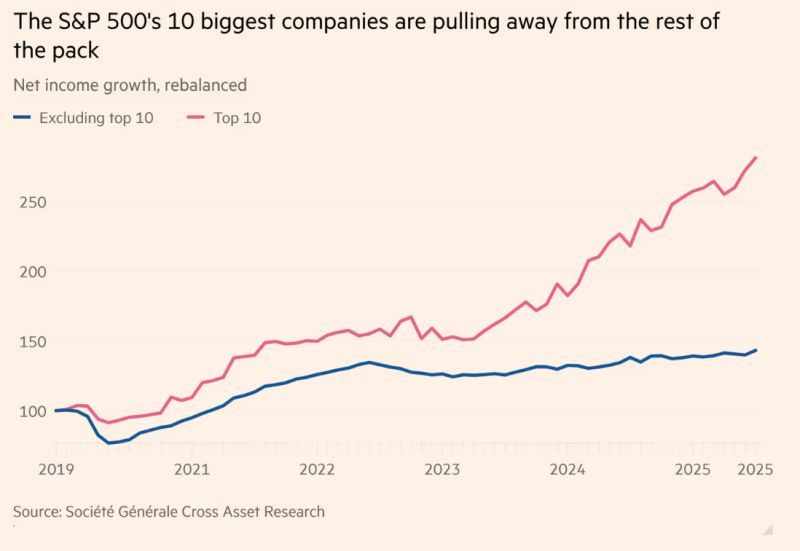
As a case in point, the S&P 500 is a US-based index comprised of the 500 (the number flactuates) largest American businesses. The top 10 — all tech companies except Berkshire Hathaway (though it owns 238 million shares of Apple) — represent 40% of the total index. The top 10 names returned 26% in 2025, while the remaining returned 12.5% — a staggering gap of 13% in one year.
If all the money in the world is set to go to giant tech firms, who then invest billions in keeping people addicted to their phones, and in turning basic communication tools into intelligent companions that learn from user behaviour and perform complex tasks autonomously, making them more interesting every day — what’s the point of anything else? And where will it end?
Of course, I wrote this piece to talk about wine, not AI.
We’ll get to wine. But first, I want you to understand that the phone is at the centre of this point — and that everything is useless except for it. If you wanted to live a minimalist life, all you need is a phone.
Everything leads to the phone.
The digital life we live in makes our analogue lives redundant.
“We all know that what we do is totally pointless,” says Swiss watchmaker Max Büsser, founder of MB&F. “A mechanical watch is totally pointless today.” He’s referring to the simple fact that mechanical watches became technologically obsolete once more accurate quartz watches, powered by a battery and a vibrating crystal, arrived.
That shift triggered the so-called Quartz Crisis of the 1970s and 1980s, when cheaper quartz watches flooded the market and the traditional Swiss industry went into steep decline. By 1984, the market for mechanical watches had shrunk to roughly a third of its size a decade earlier. However, over the four decades that followed, Swiss makers pulled off a remarkable repositioning and mechanical watches moved from functional, daily tools to luxury objects, closer to art than utility.
Büsser argues that the point of a mechanical watch is “emotional art and artisanship.” And that change in framing is precisely what has allowed the category to expand again — with forecasts projecting growth from $45.52 billion in 2025 to $101.16 billion by 2032.
If all the investment in the world goes to AI, tech… our analogue life will slowly become redundant. The digital is seamless and frictionless; our analogue life is clunky and, ultimately… useless.
kyla scanlon, one of the most interesting Gen Z economists, explained this point so well on the occasion of the protests against ICE’s actions in June 2025:
We are increasingly caught between a future promised and the present we’re living through. We have apps that can summon autonomous vehicles in minutes while we have ICE raids escalating across the country. AI evangelists talk about dancing in fields of daisies now that robots will do all the work while National Guard troops sleep on concrete floors without water (and their service members boo state governors).
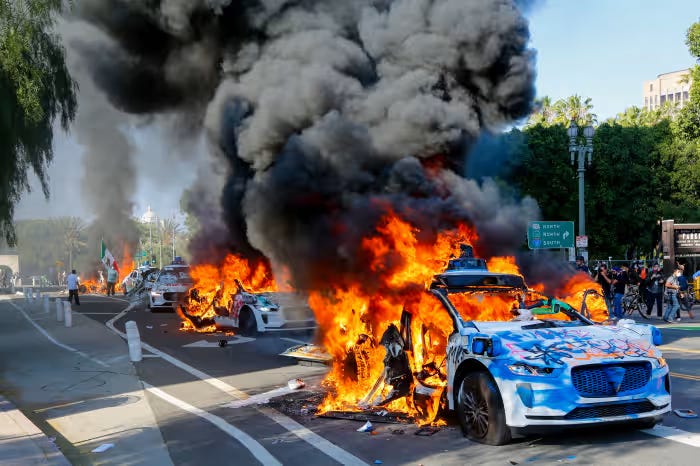
If you wanted a perfect image of this contradictions (we are a visual first society after all), I think the burning Waymos in LA are pretty searing. People used the frictionless Waymo app and the seamless user experience that the company spent billions perfecting to summon an autonomous vehicle to their exact location, and burnt it.
In this world, the reality people live in is, ultimately, the hallucination.
It’s a hallucination to think that Ozempic will give you the perfect body without creating other problems. It’s a hallucination to think that the US and its allies export democracy purely for the good of the people, or that watching people workout on YouTube will make you fit and healthy. It’s a hallucination to think that pouring all the money — and all the faith — in the world into AI and technology, whatever that means, will fix our labour market and, with it, poverty and everything else promised in Sam Altman’s “The Gentle Singularity” essay. It’s a hallucination to think that carbs and wine are the enemy, and it’s a hallucination to think that the perfect eight-hour-sleep is within reach. It isn’t. It’s a hallucination to think that trains or planes can run without infrastructure investment. They can’t. It’s a hallucination to think that movie stars are interesting. It’s a hallucination to think we can live a happy, lonely life as a unit of one — perfectly optimised beings. It’s a hallucination to think that what social media feeds us is anything but opium for the masses. It is opium. We are the masses.
There will come a point when this perfect digital life we are living — eating perfectly placed Michelin-starred food on perfectly white tablecloths, served by perfectly smiling waiters; our perfect smile, perfect Ozempic body, the perfect picture we can take with perfect cameras and instantly publish on our perfect social media feed — will crack. This mirror of perfection, this black mirror, will break into thousands of pieces, and we will need to stop the hallucination.
I’d hate for you to take away from this piece that I am anti-AI or anti-technology. Merely, I am of the opinion that, to put in the words of Henry David Thoreau in Walden we should stop becoming the tools of our tools. In such a world, the need of humanity comes first, the solution or tool second, and not the other way around.
So what is the need of humanity? Wine? Watches?
It would be absurd to suggest that humanity needs wine. Of course it doesn’t, does it?
“The wine does most of my writing,” Charles Bukowski once said, a line that sits in stark contrast to today’s “ChatGPT does most of my writing!” Am I arguing that all investment should simply flow into the pockets of wine producers instead? Of course not — though I know which kind of writing I’d rather read.
Humanity doesn’t need wine, but in my view, it stands for everything that is real, and everything that refuses to be justified by a purely utilitarian argument. It is poisonous, fattening, addictive, and shortens our days; we know what it means to battle with it, and sometimes lose. And yet, it is life-enhancing, it brings us closer to the earth, brings people together, and sits at the centre of great conversations. Wine is at once wonderful and problematic, two polar opposites, and it obeys the first rule of toxicology, as Paracelsus wrote in 1538:
“All things are poison, and nothing is without poison; the dosage alone makes it so a thing is not a poison.”
In the real life we actually live, there is room for these contradictions. Our digital life, by contrast, is increasingly intolerant of them, and the range of human expression is narrowing as a result, much as the adoption of political parties have narrowed our ability to think critically about social, economic and political issues.
We’ve reached a moment where, I think, the pendulum has swung too far towards investing in a world that isn’t our reality. Or, as Scanlon notes it in her essay:
There is something relatively poignant about using the infrastructure of the promised future to reject that future and to also the refusal to keep pretending that this future arriving through our screens has anything to do with the reality people are living in.
Even Bret Taylor, co-founder of the AI start-up Sierra and chairman of OpenAI, said that AI “probably” is a bubble, drawing both “smart money” and “dumb money” into funding competitors at every layer of the tech stack. Maybe I’m early with this call, but this black mirror may be already breaking.
Australia’s social media ban for under-16s is one timid sign of institutional and government action. Many people, like me, have started their own individual battle. While Luddites were a movement in 19th-century England of those who opposed the use of certain types of automated machinery, modern day Luddite teens instead profess a lifestyle of self-liberation from social media and technology.
It would certainly be unwise to sell your shares in companies that profit from addictive substances, whether tobacco or social media, especially given that, as of today, 20th January, I’ve already failed at quitting my phone.
But you know what they say: if at first you don’t succeed, try and try again…
I am absolutely agree with you.
From the "tech" point of view: to break the addiction with my iPhone I sold it. Now I got a very old phone of my wife, only for the business Email app, banks app and Uber. No messengers, no social networks.
But I switch my iPhone to Ipad – it works like a second screen for my laptop during work and really help. Also its stimulate to stop using "short" content and swich it to long articles like this one. But I still could be a part of online too with Ipad, not so agressive and often how it was with iphone, but it is the best decision which I found for this moment.
About the general point, I think that smartphones, Instagram and Tik Tok are the really opium of our time. And 10-20 years later we will see a "Reels Re-Hab Centers" unfortunately.
If even we, generations which got an experience with paper books, cannot to be very effective in creation of balance using smartphones... Unfortunately I think that next one generations have no got a chance.
Spot on. It’s the most logical response to the current 'neoprohibitionist' shift. We need more discussions that respect the science while acknowledging the pleasure and tradition of the vine. A much-needed reality check for the industry!