


This article was originally published on Octavian’s website, following a conversation with its Managing Director, Vincent O’Brien (🔗How can you pay for wine and it still not be yours?) about the importance of ownership for wine held in bond. Using the Oeno scandal as a backdrop, it explores a timely issue for anyone who collects wine and holds stock in bond.
Octavian Wine Services is a leading bonded fine-wine storage facility and home to some of the world’s rarest fine-wine collections, storing around £2 billion of wine across roughly 1 million cases.

The Oeno Group scandal that unfolded a week before Christmas struck at one of the most crucial, least regarded issues in wine:
Ownership.
For all the technology and sophistication of modern financial markets, commodities remain one of the last corners of the economy where the physical reality of the asset matters most — and wine is no exception.
On December 19th, the London-based wine investment, at the request of the City of London Corporation Trading Standards Service firm, published a notice stating that “Oeno has recently ceased trading.”
While there is more than a hint of foul play, what has perhaps left most Oeno Group customers perplexed is that despite promising customers “complete peace of mind” by issuing invoices and certificates of authenticity and ownership, the City of London Trading Standards Service found that “only 20% of client wine is held in individual customer accounts that the customer will be able to access.”
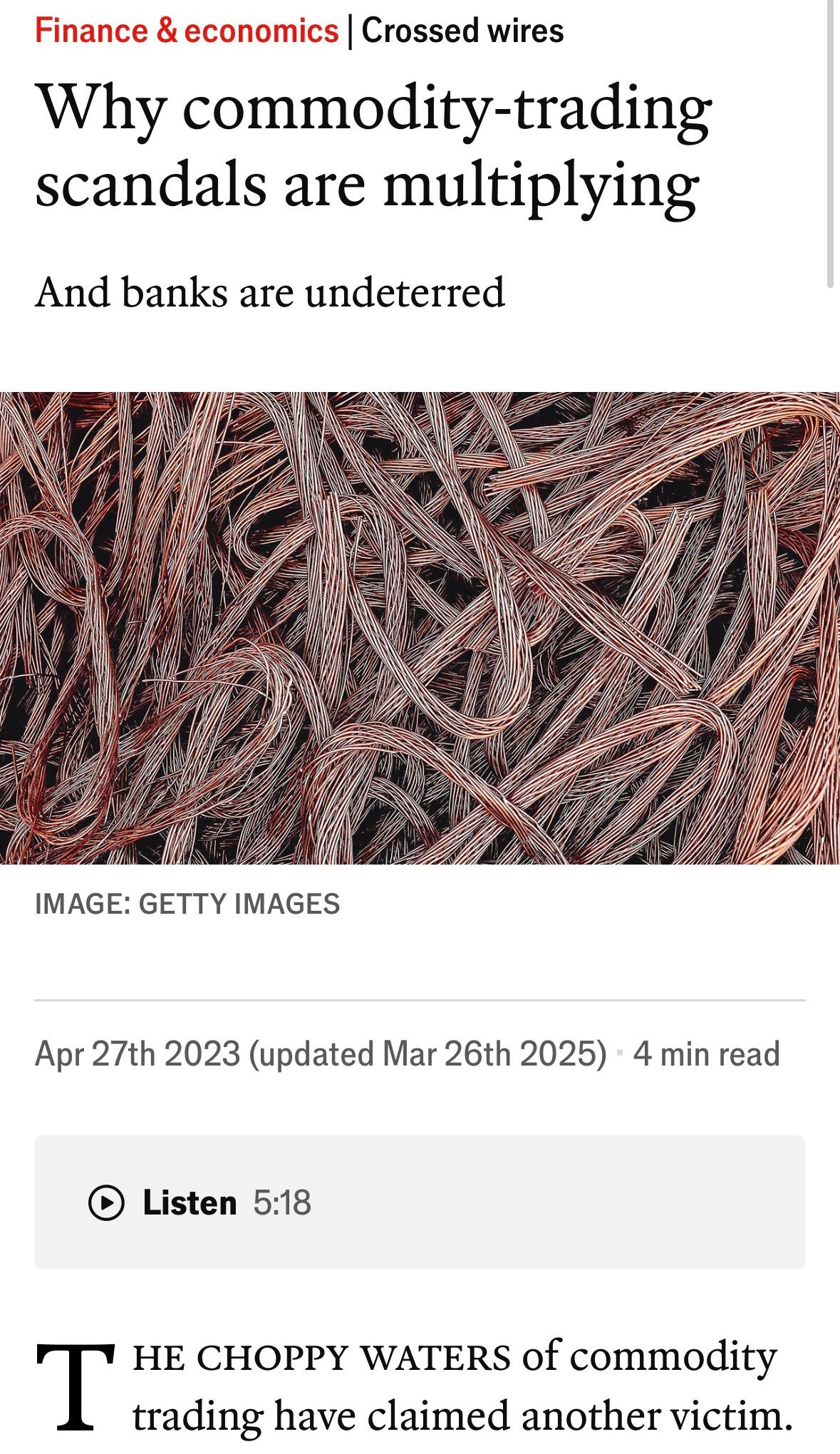
Base metals, commodities traded in volumes of more than half a million tonnes a day, still rely on warehouse receipts to prove existence and ownership, and those same documents underpin trade finance, with the commodity pledged as collateral. When receipts are forged, banks and traders can end up lending against, or buying, inventory that doesn’t exist.
Commodity fraud can happen in many ways, but the most common is physical-commodity scams, substituting valuable goods for worthless. Painted rocks passed off as copper or nickel, a scheme that reportedly left commodity trader Trafigura facing around $600m in losses, or, months earlier, the London Metal Exchange discovering bags of stones instead of nickel in one of its warehouses. Wine went down a similar path in the early 2000s when fraudster Rudy Kurniawan orchestrated one of the largest wine scams in history, selling millions of dollars’ worth of fake rare wines, fooling both collectors and major auction houses. In a mocking twist, Oeno Group itself set up an anti-fraud unit in November 2020, promising clients “complete peace of mind.”
Another classic mechanism is paperwork fraud: multiple, fake receipts issued against the same (or non-existent) inventory and sold to different parties. In the Oeno case, I spoke to Mark Sutherland, CEO of Stone Ledge Spirits, who told me that clients were sold as many as 300 non-existent barrels of their whisky.
What these schemes have in common is the failure of the customer to secure and verify physical ownership.
Does the asset exist? Where is it stored, and in what condition? Who holds it? In whose name is it recorded? Can it be identified as unique?
I’m drawing parallels with banks and trading firms because this is not a niche problem confined to “wine investment”. It can happen to anyone who loses sight of the stock itself. In commodities, everything revolves around assurance of physical ownership, whether the trade is worth £5,000 or £5 million.
Oeno did not appear to be running “investment” in any meaningful sense, but a normal merchant business, buying (and sometimes selling) like many others. Which is precisely why this is not just a problem confined to wine investment firms. If you have ever bought wine through a merchant and left it in their custody, the same question applies, even without fraud. Is the wine actually there — and is it held in your name, in a way you can access and control? If the merchant becomes insolvent and the wine is not in a segregated account, your stock can be treated as part of the estate and swept into the liquidation process, potentially ranking behind secured creditors.
So the first advice to potential wine investors is make sure the wine is held in an account in your name. Vincent O’Brien, Managing Director of Octavian Wine Services, in the recent interview put it simply: “would you let your employer open a bank account on your behalf to deposit your salary? The same logic applies here.”
Investors should insist on clear stock records; photographs showing a unique identifier (such as a rotation number) linked to your name and account; and a portal that lets you verify your portfolio.
Since the start of the scandal, I’ve spoken to people who say they have lost £10,000 to £20,000, and others who claim losses in the hundreds of thousands of pounds. The total exposure remains unclear, but it is not unreasonable to suspect that tens of millions of pounds of client money may be at risk.
Support ITMFW
Love In the Mood for Wine? A paid subscription helps keep the free edition accessible to everyone — and unlocks exclusive perks for you or simply share it to help grow the community!
It was encouraging to hear, from the poll in the last article, that 73% of you has a direct account with a bonded warehouse in your name!!!
Link > https://www.inthemoodforwine.com/p/how-can-you-pay-for-wine-and-it-still