

Fair to Whom? On the Price of Pokémon Cards, Bordeaux En Primeur, and Other Things Worth Exactly What Someone Will Pay
The wine world loves moral language but the market doesn't care.

It is not easy to determine the fair price of things. It could be because the word itself — “fair” — carries a sense of moral righteousness, as though there were some sacred duty to do the right thing and, for God’s sake, sell wine at the just price. The wine world loves this kind of language. Alas, nothing in the world is “fair”, and certainly not the markets.
Besides, what is the fair price of the coffee I am drinking as I write this? £5.30? Really?! Yet, here it is, in my hands, and I paid for it willingly.
In Bordeaux, as in many regions producing the world’s best wines, that question has become particularly difficult to answer. (And with it, the astounding pieties of the heart!)
Wine is at once a consumer good and a luxury asset. It is food, but also something to collect, store and trade and, at times, to signal status.
For most foods and beverages, pricing is still anchored to production, which is the cost of land, labour, raw materials and distribution. Margins vary, but the link between cost and price broadly remains intact. Even my £5.30 mochaccino, reckless as it is for a daily habit, ultimately reflects the cost of coffee, milk, wages and rent in whichever part of London I happen to be buying it from.
Wine was once priced much like other agricultural products: production costs plus a reasonable margin for the producer. Simon Farr, one of the most successful figures in the wine trade, with a career spanning five decades, told me that “before the early eighties, and the modern era of en primeur with Robert Parker, release prices bore some relation to a combination of cost of production plus some adjustment for prestige. It was grounded in that fundamental and left a lot on the table for those who took the wine to maturity and took the risk for that.”
But over the past four decades, Bordeaux has steadily moved away from that model. Wine no longer wants to be seen simply as food, but as a luxury good. As a result, pricing has become increasingly detached from production costs and the fundamentals of making wine. Instead, it is now driven as much by perception (and by what the neighbours are doing) as by the wine itself.
Is my £5.30 mochaccino arguably trying to position itself as something more than the bitter black coffee served in traditional British cafés? At four times the price, one could certainly make that case. What, then, would be the “fair” release price of Lafite? £20? £50? £200? At what point does the price of a bottle of wine stop being “fair”?
Perhaps, to illustrate my point, I should use Pokémon cards instead of Lafite because I assume that, if you are reading this, you either love Lafite or are dying to drink it. Which means we probably cannot be entirely objective about it.
When I hear that a Pokémon card is worth hundreds of thousands of pounds, my immediate reaction is: why? how? Surely the people obsessed with Pokémon cards are too young to own credit cards, and the people with credit cards are not obsessed with cards that have Pokémons on them? Yet, clearly, we live in a world where those two groups overlap.
But one could also speculate that, one day — perhaps not even in the unreasonably distant future — those groups (the credit cards owners and the Pokémon cards affecionados) may stop overlapping. And then what happens to the person who spent £12 million on a Pikachu Illustrator PSA Gem Mint 10 card?

The truth is that Pokémon card is only worth what somebody else is willing to pay for it. If tomorrow nobody wants it, I can tell myself it is still worth £12 million, but the market may only be willing to pay £5 for it — or whatever a pack of Pokémon cards costs these days — the market will bring the “fair” price right down to its cost of production plus a reasonable margin for Nintendo and the rest of the companies in the chain.
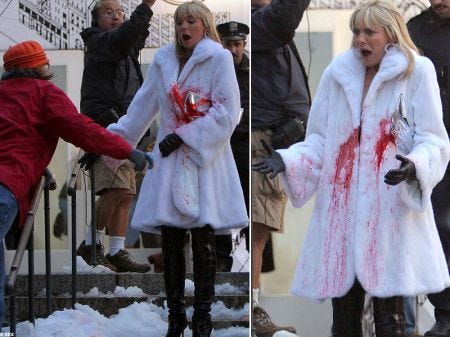
Isn’t that, in many ways, what happens for all consumer products? That they’re only worth what somebody is willing to pay for them? Take fur coats for example. I have recently inherited two—what am I to do with them?
Eventually, markets will determine price better than moral arguments ever will. The market will decide what Bordeaux is worth, what its “fair” price is, the market will find the price that truly reflects value.
In order to arrive at some reasonable measure of “fair price” for this Bordeaux En Primeur campaign, I took the current market prices of recent great vintages — namely 2016 and 2019 — and adjusted them to reflect the fact that those wines have already been aged for nine and six years longer than the newly released 2025s.
When you run that calculation, which I did, the results appear so low that it is almost inconceivable many châteaux would actually release at those prices. In some cases, for a new release to compare favourably with older vintages already available on the market, the implied fair release value is merely £2 per bottle.
Some people will argue that this is unreasonable, and I would understand why. But, on the other hand, that is what the market currently considers fair. If the trade and the châteaux cannot make money at these levels — which, in some cases, I doubt they can — that is a problem, but not for the buyer. The market is already assigning a value to these wines.
And if this En Primeur campaign is struggling, it is not because the wines are too bold, because people don’t love wine anymore because younger consumers are turning away from wine.
It is because the wines are too expensive.
*
The analysis I refer to above is set out in The Simple Framework I Use to Judge EP Pricing and The Simple Framework I Use to Judge EP Pricing – Part 2. It is one of the approaches I use to assess whether an En Primeur release is priced fairly relative to comparable recent vintages.
A few interesting findings emerged from this analysis.
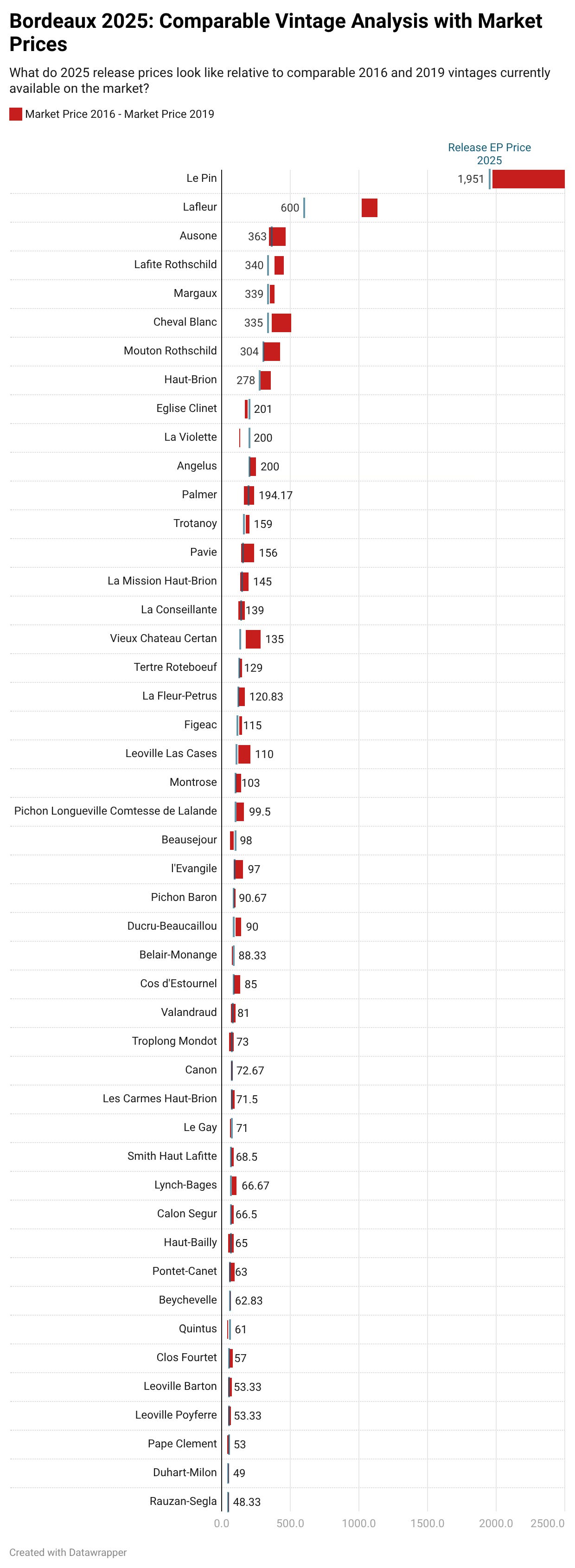
First, aside from a handful of outliers, most châteaux appear to have taken the market prices of comparable back vintages into account when setting their release prices. As the chart below shows, most 2025 releases were priced towards the lower end of the range represented by comparable 2016 and 2019 vintages currently available on the market, suggesting a growing awareness of secondary market dynamics.
However, very few châteaux went a step further and adjusted their pricing to reflect the cost of carry embedded in those older vintages—or perhaps they simply weren’t willing to price that low for reputational reasons, as the chart below shows. In fact, only Vieux Château Certan did, making it, in my view, the standout value of the 2025 En Primeur campaign.
Cheval Blanc, which produced only half its usual volume, has reportedly sold out. As for the other châteaux, were their pricing decisions enough to make the campaign a success? I’ve been told we won’t know the answer until September.
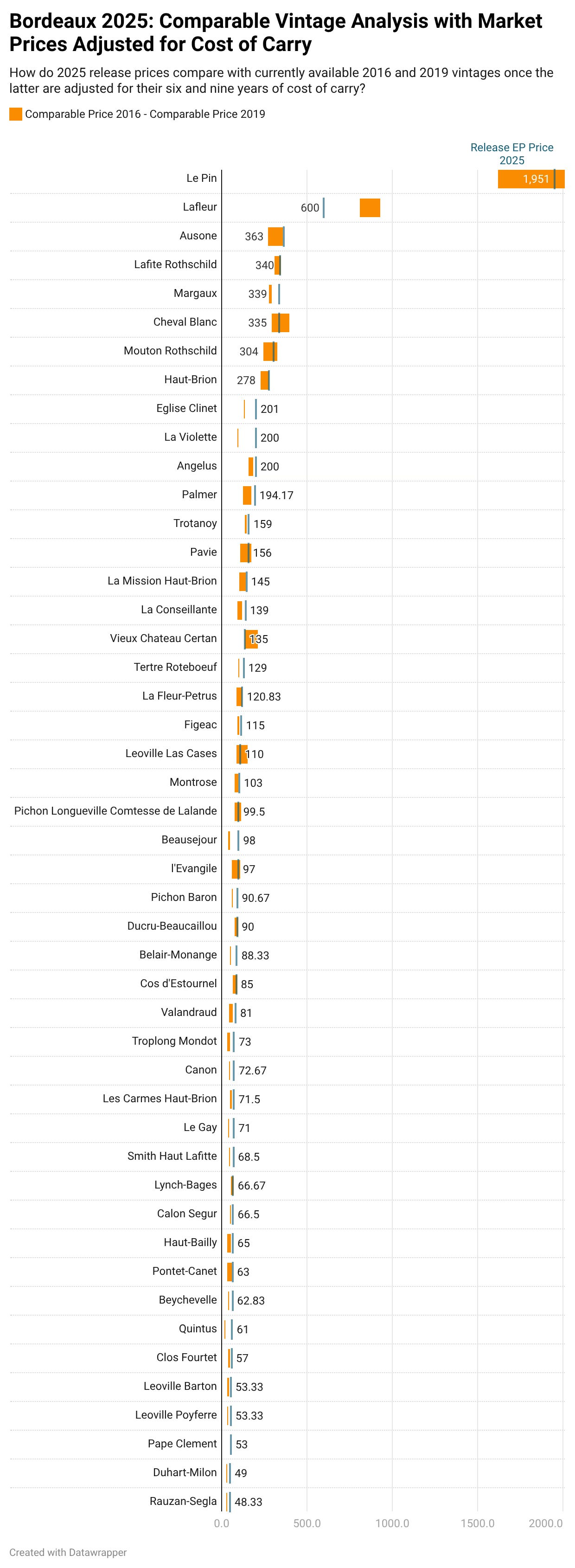
Another observation: even after adjusting for the cost of carry, the 2019 vintage remains the cheapest of the recent great Bordeaux vintages. In some cases, it is up to 66% cheaper than the current 2025 release. Go and buy some.
One final thought. Doing this analysis made me wonder whether, beyond the top châteaux, the En Primeur system still works. Or, more specifically, whether the producers that arguably need the liquidity—and the distribution network—En Primeur provides the most, because they are less well-capitalised or lack the backing of the top estates, are precisely those for whom the system has become least effective. Has La Place gradually evolved into a marketplace primarily for super-premium châteaux and wines?
*
What do you think of the 2025 Bordeaux En Primeur campaign? Did you buy anything—or did you opt for older vintages instead?
Thanks, as always, for being here.
Sara
*
A version of this article was originally published on Octavian Wine Magazine The Vault. Octavian is one of the world’s leading bonded fine wine storage providers, safeguarding around £2 billion worth of wine across approximately one million cases, including some of the rarest collections in existence.
I appreciate the work here, and I think the pricing analysis is useful, but I also think this misses the larger point. Bordeaux’s problem isn’t simply that the 2025s are too expensive relative to 2016 or 2019. It’s that the whole conversation has been reduced to this: the same estates, the same hierarchy, the same annual release nonsense, the same price nitpicking.
En primeur doesn’t just reveal Bordeaux’s pricing problem. It creates Bordeaux’s identity problem. It forces the region to introduce itself every year as a financial instrument rather than as wine, farming, restaurants, culture, discovery, or drinking pleasure.
Imagine any other region allowing itself to be defined this way. Imagine Burgundy’s global conversation being reduced every year to whether Rousseau, Roumier, DRC, Leflaive, and Coche released at the correct discount to back vintages. People would start hating Burgundy too. Burgundy just hides the Porsches and Ferraris better. Bordeaux makes the machinery visible, then wonders why everyone finds it vulgar.
So yes, the wines may be too expensive. But that feels like the symptom, not the disease. The disease is that Bordeaux has let its most boring economic ritual become its public face. At some point the answer is not a fairer en primeur price. It’s admitting that en primeur, at least as the dominant regional narrative, needs to die.
I really appreciate your work Sara, keep going!
I have a clarification request please. I am seeking to understand the pricing information presented.
I note that you specifically highlight the value presented by VCC, looking at the data is not Lafleur also worthy of comment? ie the Lafleur 2025 en primeur price seems particularly favourable in relation to ‘16/‘19.
Many thanks